题面
给你一个 m 行 n 列的矩阵 matrix ,请按照 顺时针螺旋顺序 ,返回矩阵中的所有元素。
示例 1:
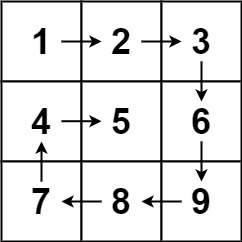
输入: matrix = [[1,2,3],[4,5,6],[7,8,9]] 输出:[1,2,3,6,9,8,7,4,5]
示例 2:

输入: matrix = [[1,2,3,4],[5,6,7,8],[9,10,11,12]] 输出:[1,2,3,4,8,12,11,10,9,5,6,7]
提示:
m == matrix.lengthn == matrix[i].length1 <= m, n <= 10-100 <= matrix[i][j] <= 100
分析
-
对于这种问题,可以定义一个方向数组,当达到边界条件时,就更改方向,直到最终达到最后的位置
-
需要注意的是,随着一整论循环的增加,其边界条件的判定也应该修改
-
模拟即可
class Solution { public: vector<int> spiralOrder(vector<vector<int>>& matrix) { vector<int> dx = {0, 1, 0, -1}; vector<int> dy = {1, 0, -1, 0}; vector<int> result; int x = 0, y = 0, cur = matrix.size() * matrix[0].size(); int direction = 0; int loop = 0; bool added_loop = false; while (cur-- > 0) { result.push_back(matrix[x][y]); if (!added_loop && direction == 3) { loop++; added_loop = true; } // std::cout << loop << " " << x << " " << y << " " << std::endl; if ((direction == 0 && y == matrix[0].size() - 1 - loop) || (direction == 1 && x == matrix.size() - 1 - loop) || (direction == 2 && y == loop) || (direction == 3 && x == loop)) { direction = (direction + 1) % 4; added_loop = false; } x += dx[direction]; y += dy[direction]; // std::cout << x << " " << y << " " << std::endl; } return result; } }; -
可以用边界收缩法代替原代码复杂的方向 + loop 判定逻辑
#include <vector>
using namespace std;

class Solution {
public:
    vector<int> spiralOrder(vector<vector<int>>& matrix) {
        // 处理空矩阵的特殊情况
        if (matrix.empty() || matrix[0].empty()) {
            return {};
        }

        vector<int> result;
        // 定义四个边界
        int top = 0;                  // 上边界
        int bottom = matrix.size() - 1; // 下边界
        int left = 0;                 // 左边界
        int right = matrix[0].size() - 1; // 右边界

        // 当边界不交叉时继续遍历
        while (top <= bottom && left <= right) {
            // 1. 从左到右遍历上边界
            for (int i = left; i <= right; ++i) {
                result.push_back(matrix[top][i]);
            }
            top++; // 上边界向下收缩

            // 2. 从上到下遍历右边界
            for (int i = top; i <= bottom; ++i) {
                result.push_back(matrix[i][right]);
            }
            right--; // 右边界向左收缩

            // 防止单行/单列时重复遍历
            if (top > bottom || left > right) {
                break;
            }

            // 3. 从右到左遍历下边界
            for (int i = right; i >= left; --i) {
                result.push_back(matrix[bottom][i]);
            }
            bottom--; // 下边界向上收缩

            // 4. 从下到上遍历左边界
            for (int i = bottom; i >= top; --i) {
                result.push_back(matrix[i][left]);
            }
            left++; // 左边界向右收缩
        }

        return result;
    }
};
这篇文档有帮助吗?